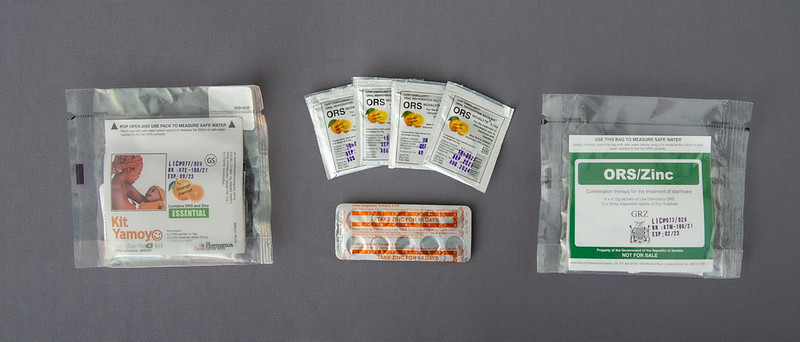
Commercial co-pack (Kit Yamoyo) and the government-branded co-pack
Coca-Cola gets everywhere – life saving medicines don’t.
This was the observation – somewhat naive but also headline-grabbing – that inspired us to investigate private sector distribution of ORS and Zinc for diarrhoea.
The results from our first trial to develop the private sector – The ColaLife Operational Trial in Zambia or COTZ – were promising. COTZ focussed on value chain development – the same process that gets Fast Moving Consumer Goods into even remote villages. Value Chain thinking seemed to tell us, that if washing powder and fizzy drinks can arrive in small shops all over Zambia, why can’t we apply the same technique to a better designed pack containing ORS and zinc for children’s diarrhoea? The trick was to make the product attractive, effective, desirable, well-known – aspirational even. Most importantly, it had to be affordable; and profitable for the manufacturer, wholesalers and retailers all along the value chain. COTZ was impactful: in just 12 months, with value chain stimulation that included retailer training in the basics of diarrhoea prevention and product benefits, ‘sensitisation’ of health staff and of customers working through existing Community Health Workers, ORS and Zinc coverage increased from 1% at baseline to 45%.
This was set against a promising background in Zambia: In 2013, the government had put forward the Medicines and Allied Services Bill, aiming, among other things to provide the policy framework for a network of licensed Drug Stores, similar to the successful ADDO network in Tanzania. At that time, Zambia had fewer than 100 pharmacies nationwide, and most of these were in the main towns. Although ORS and Zinc could, in theory, be sold ‘over the counter’, without prescription, a network of outlets, retailer training, and public awareness – particularly for zinc – didn’t exist. Continuing Public Health stock outs of simple medicines meant many health facility staff – right up to government level – could see potential for a private sector option. The ground looked favourable for a scale-up project promoting the innovative new easy-to-use ORS and zinc co-pack (Kit Yamoyo) through retailer networks.
But our attempts to scale up the trial model met with funding difficulties. Finally, we were able to launch KYTS-LUSAKA (2015-2018) in the capital province only. This developed the COTZ model of retailer training and value chain stimulation in a more populated, better served province, in partnership with health facilities, where ‘sensitised’ staff who knew the benefits of the Kit Yamoyo product signposted patients to trained retailers. The public sector continued to distribute ORS and zinc separately in Lusaka Province and did not have access to the new co-pack until after the project ended.
Alongside KYTS-LUSAKA, our partner KZF won funding, with our help, for a project under the SUN (Scaling Up Nutrition) programme, to increase coverage of zinc, through awareness raising and distribution of the Kit Yamoyo Co-pack. The SUN districts were prescribed: remote districts of Zambia where zinc coverage was around only 1% and child stunting through poor nutrition and diarrhoea was rife – high need, but not ideal for private sector development. KYTS-ACE (Feb 2015 to Aug 2016, with a limited extension to Dec 2017 for endline) covered 14 remote/rural districts of Zambia. KYTS-ACE and KYTS LUSAKA were the only Zinc awareness and distribution projects that we know of promoting zinc at that time. We selected 11 of the KYTS-ACE districts to support public sector distribution of the new ORS/Zinc co-pack via Medical Stores Ltd (MSL) (the government’s medicines distributor). This was underpinned by community sensitisation and health facility staff training in ORS and Zinc and the benefits of the co-pack in particular. In the remaining 3 districts, where the private sector had some potential (Mongu, Mumbwa and Kasama), we applied the COTZ private sector model only; the public sector distribution of Kit Yamoyo did not take place until after the project ended. In one district among the 11, Chipata, we applied both models. The model of the intervention can be seen here: KYTS-ACE gets underway.
It must be said that funding for both projects was spread very thin. In terms of marketing and promotion, we were not able to launch a full, nationwide promotion of Kit Yamoyo. For example, there was no activity in the populous Copperbelt. Promotion was limited to signposting by trained health staff, events such as Child Health Week, some radio coverage and a limited use of billboards, supplemented with local posters. In the 4 ‘private sector’ districts where around 400 retailers were trained in total, they were responsible for their own marketing and they bought the product with their own funds, either from a trained wholesaler or from the Shoprite supermarket chain, which sold the Kit Yamoyo i in Kasama and Mongu (and also in Lusaka). There was a limited use of discount vouchers to kick start the value chain in the 4 private sector development districts. In terms of private sector development for a new product, it was far from ideal.
So, what did we learn about public vs private sector development for improving access to ORS and Zinc in Zambia?
As mentioned above, the private pharmaceutical sector in Zambia is one of the weakest in Africa. The policy to develop a network of licensed Drug Stores has not got underway. KYTS-LUSAKA (private sector development only, alongside Health Facility awareness and signposting) had some success, with coverage of ORS and Zinc rising from 13% at baseline to 33% at endline. Kit Yamoyo use accounted for 1o percentage points of that 20 percentage point improvement, the rest coming from improvements in the public sector, which only had the usual stock of separate ORS and zinc on offer.
The impact of the small scale, private sector development under KYTS-ACE was found to be small. This contrasted with the impact in the public sector seen in other KYTS-ACE districts. Here, coverage data and feedback from Health Staff was very encouraging for MoH who were involved at national level in all 3 projects (COTZ, KYTS-ACE and KYTS-LUSAKA) through a Learning and Steering Group which met quarterly from 2011 to 2018. In Feb-2017, as a result of the work of the Learning and Steering Group, a ground-breaking new agreement was reached with MSL to distribute one box of co-packs (150 individual co-packs) with every Health Centre Kit (containing a limited amount of ORS and Zinc packaged separately) distributed to Health Centres in the SUN Districts. This was a significant change in MSL Policy. Under the new system ORS/Zinc co-packs were ‘pushed’ out to Health Centres rather than waiting for Health Centres to order them.
By the time of the final Learning and Steering Group, held last month, the government has committed to distribute the new co-pack (a government branded version of Kit Yamoyo) across the country, and has pledged to procure and distribute on an ongoing basis.
In the final analysis, the MoH has the purchasing power (through donor funds) to be a large scale, reliable customer for the local manufacturer. The government has the distribution network (through MSL) to reach the whole country with the new ORS/Zinc co-pack, distributing it for free through government facilities in areas where poverty and limited buying power make retail value chains very hard to establish. Whilst the retail route is considered an important supplementary route, and this gives the manufacturer continual small orders (for example, via Shoprite) the time needed for Zambia to develop a robust retail market for drugs in remote areas has not yet arrived.
UPDATE Jun-2023. An event looking at the latest sales figures and institutionalisation of Kit Yamoyo in Zambia is elaborated here: Quantifying the Kit Yamoyo Legacy
UPDATE Feb-2024. These issues are explored in more detail in Berry J et al 2024: Institutionalizing Innovation: From Pilot to Scale for Co-Packaged Oral Rehydration Salts and Zinc—A Case Study in Zambia

